
Wharton Projected Release Meaning
TDCJ uses the formal field name Projected Release Date. Classification and Records calculates it as the expected release from incarceration if parole does not occur sooner. The offense date and legal eligibility control the calculation. The projection is not necessarily the day supervision ends, and it may move as Board action, good-conduct classification, forfeiture, sentence data, or other controlling information changes.
For an eligible offense committed before September 1, 1996, the state definition can reflect the point at which flat time plus good time equals the sentence, absent earlier parole. For an eligible offense on or after that date, discretionary mandatory supervision requires Board approval. A denial can cause recalculation toward maximum expiration or discharge. For a person not eligible for mandatory supervision, the projected field ordinarily tracks maximum expiration absent earlier parole.
| Date field | What it means | Does it prove release? |
|---|---|---|
| Projected Release Date | TDCJ calculation for expected release from incarceration under governing rules | No |
| Scheduled Release Date | Operational date calculated after favorable action and processing | No, it can change |
| Maximum expiration / discharge | End point under sentence records, subject to the record's exact context | Confirm with history |
| Actual release entry | Recorded departure from the named facility | Yes, from that facility only |
A Wharton County Jail release date follows a different record path. TDCJ does not calculate every local jail sentence. WCSO's current and released records show custody events, while the signed judgment and WCSO's individual calculation explain when a county sentence may end.
Lookup Wharton TDCJ Dates
Use the TDCJ inmate search only when the person was sentenced or transferred to TDCJ, has state incarceration history, or is under state parole or mandatory supervision. The search accepts a TDCJ number, State Identification number, or name. Race and gender filters can narrow a common name. An official number is more reliable than spelling.
- Enter the TDCJ or SID number when known. Otherwise search the full name and apply only accurate optional filters.
- Open Offender Information Details. Match the date of birth, offense, county of conviction, sentence, and current location or status.
- Read Projected Release Date with maximum, parole, and sentence fields. Do not isolate one date from the rest of the record.
- Open Parole Review Information when present. A favorable vote is a decision, not an actual prison release.
- After processing, look for Scheduled Release Date and Scheduled Release Location. Confirm again after the date passes.
The official TDCJ search form is shown below from its state source.
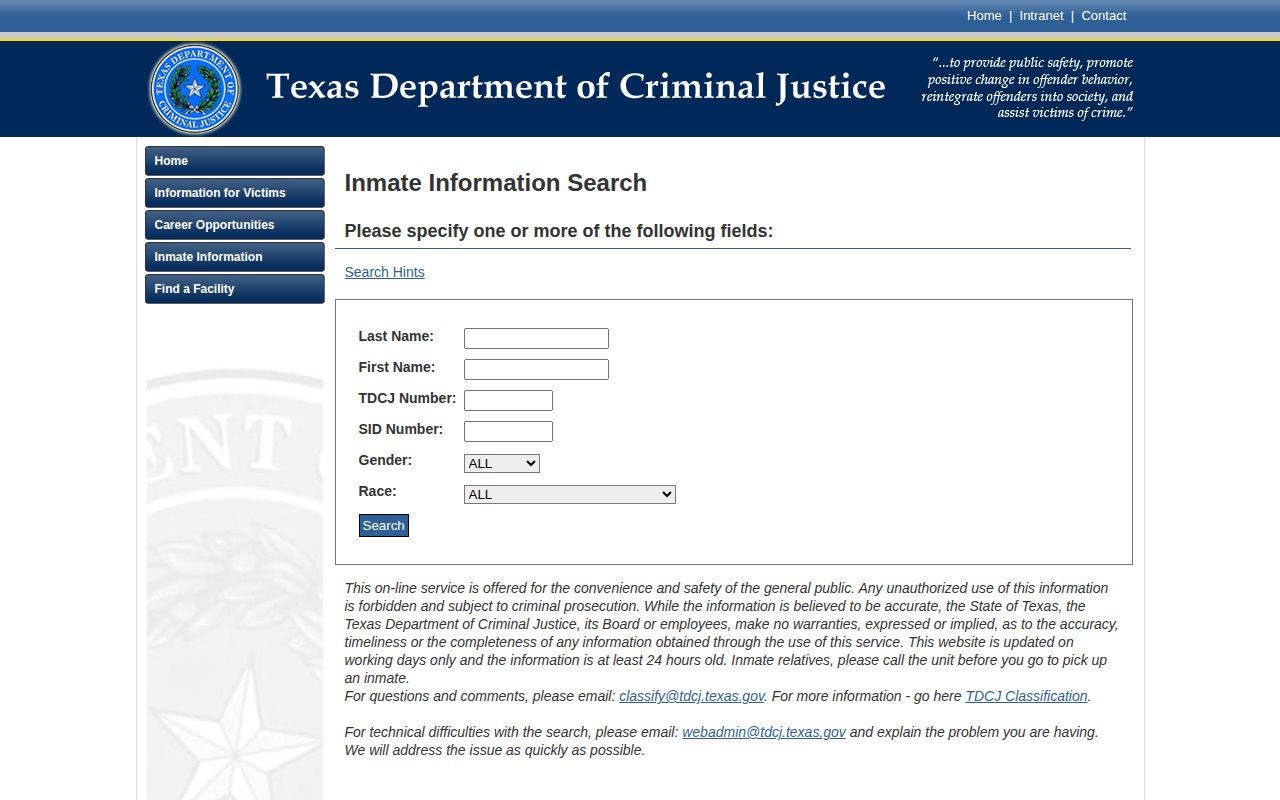
The state form demonstrates why a county jail booking number is not enough. Use the state identifiers and conviction data when the custody path reached TDCJ.
Wharton Scheduled Release Processing
After a favorable Board vote, TDCJ Review and Release Processing checks the release plan, county-of-residence rules, special conditions, program completion, discipline, and other criteria. It reviews the certificate and coordinates release when the person is eligible. The Ombudsman information says that, once Classification and Records receives the certificate, the audit and scheduled-date calculation commonly take about 14 to 21 business days in that described stage.
The resulting Scheduled Release Date and Scheduled Release Location are more operational than the earlier projection, yet TDCJ warns that they can change without notice, even on the named day. A detainer, unresolved plan, required program, discipline, or another legal event may interrupt release. Call the Parole Division release-status line at 512-406-5202 after a favorable vote. Before a Board vote, use 844-512-0461. General location and status lines are 936-295-6371 and 800-535-0283 on weekdays from 8 a.m. to 5 p.m.
Do not treat parole eligibility as release approval. Texas Government Code sections 508.145 and 508.149 apply offense-specific rules and mandatory-supervision exclusions. The Board retains discretion where the law calls for it. A favorable vote may also be withdrawn if new information arrives.
Once an actual release occurs, identify its type. A parolee or mandatory-supervision releasee has left prison but remains under supervision. A discharged person has completed the incarceration and associated sentence or supervision shown in the official state history. The Wharton County probation and parole record path explains those post-release distinctions.
Texas Good Time Calculations
Texas Government Code Chapter 498 authorizes good-conduct classifications and credits. Section 498.003 addresses awards based on classification and participation, while section 498.004 allows forfeiture. The key limit is often missed: good-conduct time applies to parole or mandatory-supervision eligibility as Chapter 508 permits and does not otherwise reduce the sentence term.
For some serious offenses, section 508.145 uses actual calendar time without good-conduct credit equal to one-half of the sentence or 30 calendar years, whichever is less, subject to statutory minimums and the exact offense category. Other cases have different calculations. Section 508.149 excludes listed cases from mandatory supervision. Therefore, no universal percentage can safely predict a Texas release.
There is no general Texas rule that every prisoner serves 85 percent. Multiplying a sentence by 0.85 can produce a confident but false date. A correct review needs the conviction statute, offense date, sentence, enhancements, consecutive terms, jail credit, and the version of law that controls. Then the displayed TDCJ calculation should be treated as the agency's current answer, not independently reverse-engineered.
- Flat time
- Actual calendar time served.
- Good-conduct time
- State credit used for eligibility only as the governing statutes allow.
- Parole eligibility
- The first point at which the Board may consider release, not a promise of approval.
- Detainer
- A request or legal hold that may send a person to another authority instead of the community.
Wharton Jail Good Time
Wharton County jail time is a distinctive local calculation. Texas Code of Criminal Procedure Article 42.03 requires qualifying pre-sentence jail credit in the judgment. Article 42.032 permits a sheriff to grant commutation for good conduct, industry, and obedience, up to one day for each day of the original sentence actually served. The statute says may, not must.
Article 42.032 also calls for an individual conduct and calendar record that reflects the award and forfeiture of credit. No Wharton-specific online policy proves that WCSO grants the maximum credit in every case. A sound county calculation therefore starts with the signed judgment, credited days, sentence start, consecutive causes, and the individual's conduct record. Ask WCSO for its current policy and the person's calculation rather than relying on a generic county-jail formula.
A hold or transfer order can prevent community release even when the local sentence is satisfied. The WCSO record may show release from Wharton County Jail, while TDCJ, another county, federal authorities, or ICE shows continued custody. No researched Wharton rule supports a promised weekend or holiday early release.
- Obtain the signed judgment and verify the exact sentence and jail credit.
- Match the judgment to WCSO booking and custody dates.
- Ask for the current good-time policy and the individual conduct/calendar calculation.
- Check for detainers, warrants, consecutive causes, and transfer orders.
- Confirm the actual event in WCSO Released after the expected date.
Note: A local release calculation should be dated, because later court orders, forfeitures, or holds may change it.
Confirm Wharton Actual Release
For a state record that remains unclear, use the TDCJ email request channel. Supply the full name and seven-digit TDCJ number. If that number is unknown, provide exact birth date or approximate age and county of conviction. Ask for incarceration history, Projected Release Date, release type and date, discharge date, and supervision termination. TDCJ says the information is free.
TDCJ's email channel does not provide inmate photographs, and its projected date remains a calculation. Telephone routes are better when active release processing is the issue. Written history is stronger for an older state discharge. For a county release, use WCSO's Released detail and request a defined release sheet if the online record is missing.
Read the court case too. The WCSO detail supplies Court Type and Docket Number, which can point to the correct Wharton clerk. A court disposition may show sentence completion, probation, dismissal, or a later order that the custody screen cannot explain. The County Clerk portal and District Clerk serve different jurisdictions.
A past projection, a favorable vote, and an alert are not substitutes for the final record. Match the person, state or county identifier, custody system, actual release entry, release type, and court cause. That chain distinguishes a true community release from a transfer and distinguishes release under supervision from full discharge.
Why Wharton Release Dates Change
Dates move when facts or legal controls move. A corrected sentence, newly entered jail credit, forfeited good time, consecutive cause, detainer, discipline, required program, or revised plan can affect processing. Board action can change the route without proving departure. Even a Scheduled Release Date remains subject to audit.
County and state calculations should never be merged. WCSO calculates a county sentence under the judgment and lawful credit practice. TDCJ calculates state fields under the conviction, offense date, sentence, and statutes. A transfer from Wharton County Jail to TDCJ ends WCSO custody but not state incarceration.
Ask the office that owns the field to explain a discrepancy. The court owns its judgment. WCSO owns local custody records. TDCJ owns projected and scheduled fields. The Board owns its parole decision. Separating those roles prevents a preliminary date from becoming a false final date.
Match Wharton Release Date Fields
Build a record set before calling. For WCSO, collect the full name, booking date, release row, court type, and docket number. For TDCJ, collect the TDCJ or SID number, birth data, county of conviction, offense, sentence, current location, and every date label exactly as displayed.
| Question | Record |
|---|---|
| When did local custody end? | WCSO release sheet |
| How was the county date calculated? | Judgment and individual conduct record |
| What is the state projection? | TDCJ Offender Information Details |
| Was parole approved? | Parole Review Information |
| Did supervision end? | TDCJ history or court discharge order |
Label every copy with its access date. Public interfaces are current views, not frozen certificates. A later recalculation may be correct even when an older screenshot was accurate when made.
Wharton Release Date History
Historical confirmation requires more than the public screen. Ask TDCJ for incarceration history and discharge data, or ask WCSO for the defined local release sheet. If sources conflict, the agency responsible for the disputed field should resolve it.
Never combine sentences into a quick estimate. Concurrent terms may run together, while consecutive terms do not. Jail credit may attach to one cause. A later revocation can create another custody episode. These facts make a hand calculation unreliable even when the sentence appears simple.
Search Release Dates
Sponsored Results