
Understanding Wharton County Releases
“Released” marks the end of one custody episode. It does not always mean the person returned to the community. The Wharton County Sheriff’s Office may release a person to the street, accept a bond, transfer the person to another county, or hand custody to TDCJ, federal authorities, or ICE. Each result requires a destination check. A person moved to another agency has left Wharton County Jail, yet remains in custody.
The official WCSO Detention Center Network, or DCN, separates Current and Released records. Current mode shows people housed by WCSO now. Released mode preserves ended bookings and the reason or method tied to that exit. Court records show what happened to the charge. TDCJ, BOP, and ICE answer separate custody questions.
Wharton County Release Types
The release method determines the next record. Bond ends a jail stay while a case may continue. Time served may mean the sentence itself or credit applied at sentencing. A transfer ends WCSO custody but begins or continues custody elsewhere. Parole and mandatory supervision allow a person to leave state prison while the sentence continues. Discharge has greater finality because TDCJ defines it as completion of incarceration and attached supervision.
| Event | What it establishes | Next source |
|---|---|---|
| Street or bond release | WCSO custody ended for that booking | Court docket and bond terms |
| Time served | Jail credit or sentence may end the stay | Signed judgment |
| TDCJ transfer | County custody ended, state custody began | TDCJ offender detail |
| Federal or ICE handoff | Another authority may hold the person | BOP, federal case, or ICE locator |
| Parole or mandatory supervision | Prison stay ended, sentence continues | TDCJ and Parole Division |
Wharton County Release Record Fields
The released grid shows full name, age, race, sex, admit date, release date, and time in jail. Its filters help separate common names and repeat bookings. Opening a detail adds the facts needed to understand the exit. Blank fields can occur, so silence should not be filled with an assumption.
| Field | Meaning |
|---|---|
| Admit and release date/time | Start and end of the specific WCSO stay |
| How Released | The physical movement, such as release to street |
| Release Reason | The legal or administrative basis |
| Court Type and Docket Number | Route to the case disposition |
| Bond and Bond Type | Booking bond data, not proof the case ended |
| Charging and Arrest Agency | Office that may hold the incident record |
| Photo and descriptors | Identity aids to check against other fields |
Request Wharton County Release Records
A public DCN result is useful for quick verification. A focused request is stronger when a stable copy, full movement history, or booking photograph is needed. The request should seek existing records, not ask the sheriff to reach a legal conclusion.
- Identify the person, admit date, release date or narrow range, and any booking or docket number.
- Ask WCSO for the booking sheet, release sheet, movement history, and photo tied to that booking.
- Send the request through the governmental body’s public-information route and keep proof.
- Ask for electronic copies and segregable public portions if some material is withheld.
- Use the docket number to seek the judgment, dismissal, sentence, or supervision order.
P.O. Box 726
Wharton, TX 77488
979-532-1550
Fax: 979-282-2849
Texas Law and Wharton Records
The Texas Public Information Act governs access, exceptions, procedure, cost, and timing. No source sets a guaranteed DCN display period. Old bookings show historical depth, not permanent availability. Texas State Library schedules set minimum retention classes, while the sheriff’s adopted schedule and disposition authority govern its files.
Expunction under Code of Criminal Procedure Chapter 55A and nondisclosure under Government Code Chapter 411 are different remedies. Eligibility depends on the charge and result. A lawful order can restrict public access, but a missing web row alone does not prove an order exists.
A request should name the records with enough care for WCSO to locate them. Useful terms include booking record, release sheet, movement log, booking photograph, and the record-control schedule for the category. Ask for a defined person and date range. If the agency invokes an exception, the written response and cited authority make clear what was withheld and why. The Texas Attorney General’s public-information guidance advises sending the request to the governmental body’s public-information officer and describing existing records.
Fees are not safe to guess. Texas law supplies a cost framework, but no research source establishes one fixed WCSO price for every release request. Ask for an estimate before work begins if the request may be large. Electronic delivery and a narrow booking range can reduce search and copy work. A court clerk has a separate fee schedule for certified judgments and copies, so jail and court requests should remain separate.
Booking photos are government records when held by the sheriff, though an exception can depend on context. Wharton already publishes photos on many released details. That online channel does not waive every possible exception for every image. Ask for the photo linked to a defined booking and request the legal basis if it is withheld.
Read Wharton Release Records Carefully
The release date and time are the strongest direct evidence that WCSO ended one custody episode. They should be tied to the admit date because the same person can return on another booking. “How Released” describes movement. “Release Reason” describes the legal or administrative basis. Both fields should be transcribed, since collapsing them can turn a transfer into an apparent street release or a bond into an apparent case dismissal.
“Time served” also needs the judgment. It can refer to the sentence itself or to credit the court applied at sentencing. A dismissal or acquittal comes from a court record, not from the jail’s exit label. Death may use an administrative exit field but should not be described as a released person. When a value is abbreviated or blank, seek the movement record rather than decode it from context.
Identity needs the same care. Age and physical descriptors narrow a match, yet names, aliases, and spellings can overlap. Booking dates, court type, docket number, charging agency, and arrest agency create a more reliable combination. The safest statement remains booking-specific: WCSO records show that the booking admitted on a stated date ended on a stated date by a stated method.
No single packet answers all questions. The released DCN detail establishes what the public county system displayed. A sheriff-produced movement sheet preserves the agency record. A court judgment or current docket addresses disposition. A receiving agency’s result addresses custody after transfer. Together, those sources reduce errors caused by lag, common names, and movements between systems.
Search Wharton County Released Inmates
Start with the system that held the person. A name-only web query can miss Wharton’s official archive. Use booking dates, age, court, docket, and agency fields to prevent a false match.
- Open DCN from the official sheriff page, switch from Current to Released, and search.
- Open the booking and record release date/time, How Released, Release Reason, and destination clues.
- Check the court docket if the result says bond, time served, dismissal, or supervision.
- Search TDCJ for a state transfer. Use BOP, the federal case, or ICE for those authorities.
- Request the release or movement record when the online result is absent or unclear.
For a narrow recent window, use the Wharton County Jail Releases: 24 Hours route.
TDCJ Search for Wharton Releases
The TDCJ inmate search is for state custody and supervision, not every Wharton jail booking. Search by TDCJ number or SID when possible. A name plus race and gender can narrow results. Read location, offense, county, sentence, and dates together.
Projected Release Date is an estimate, not proof of departure. Scheduled Release Date follows later review and audit and can still change. Parole and mandatory supervision mean the prison stay ended while the sentence continues. Discharge means the sentence and attached supervision ended.
| Field | Use |
|---|---|
| TDCJ number | Best direct state identifier |
| SID | Texas state identification number |
| Name | Use with exact spelling and other facts |
| Race and gender | Optional narrowing controls |
| County of conviction | Confirms the case connection |
The official form shows the state identifiers used for a Wharton case that entered TDCJ custody.
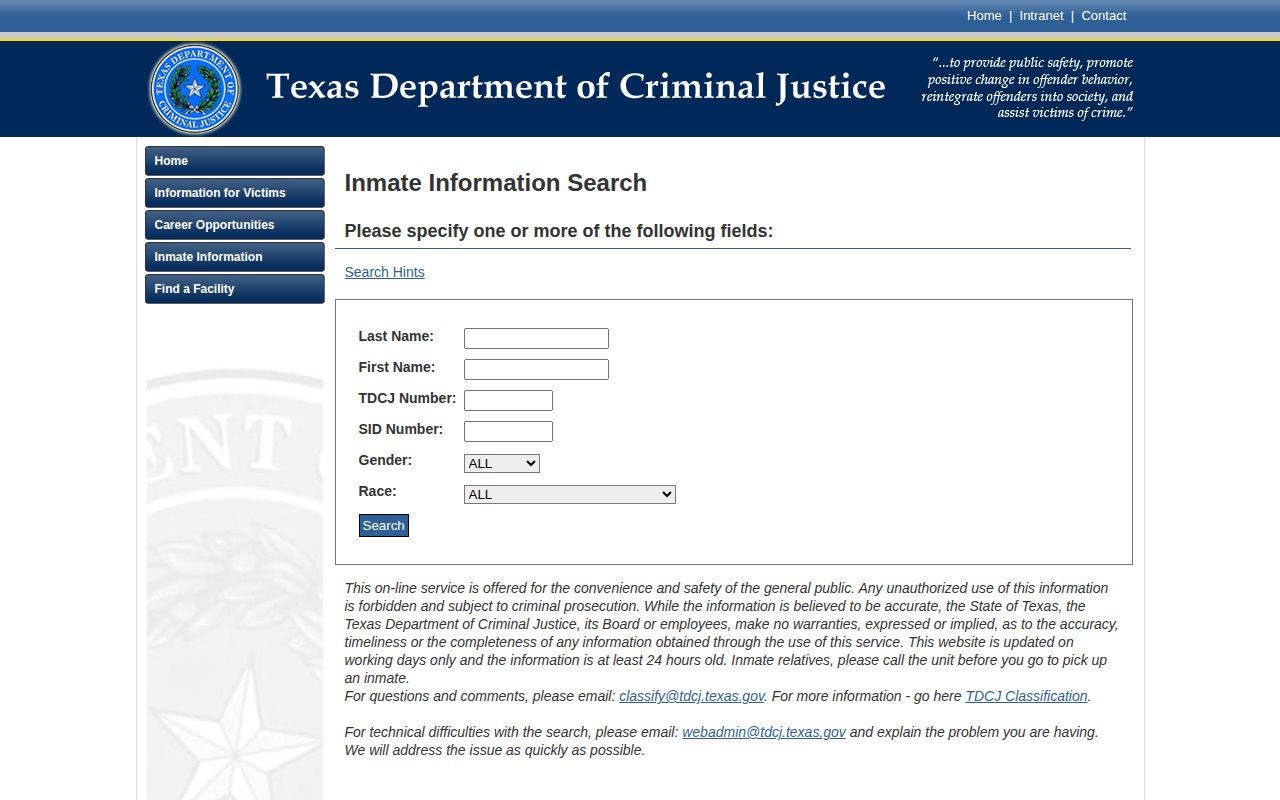
This state search follows, but does not replace, the WCSO booking record.
Browse Wharton County Recent Releases
Released mode offers name, charge, and “Over the last number of days” controls. Enter 1 for a practical one-day query or 3 for a three-day query. The publisher does not define rolling-hour boundaries or refresh timing, so read each displayed date and time.
The all-released grid can be filtered if the day submission fails.
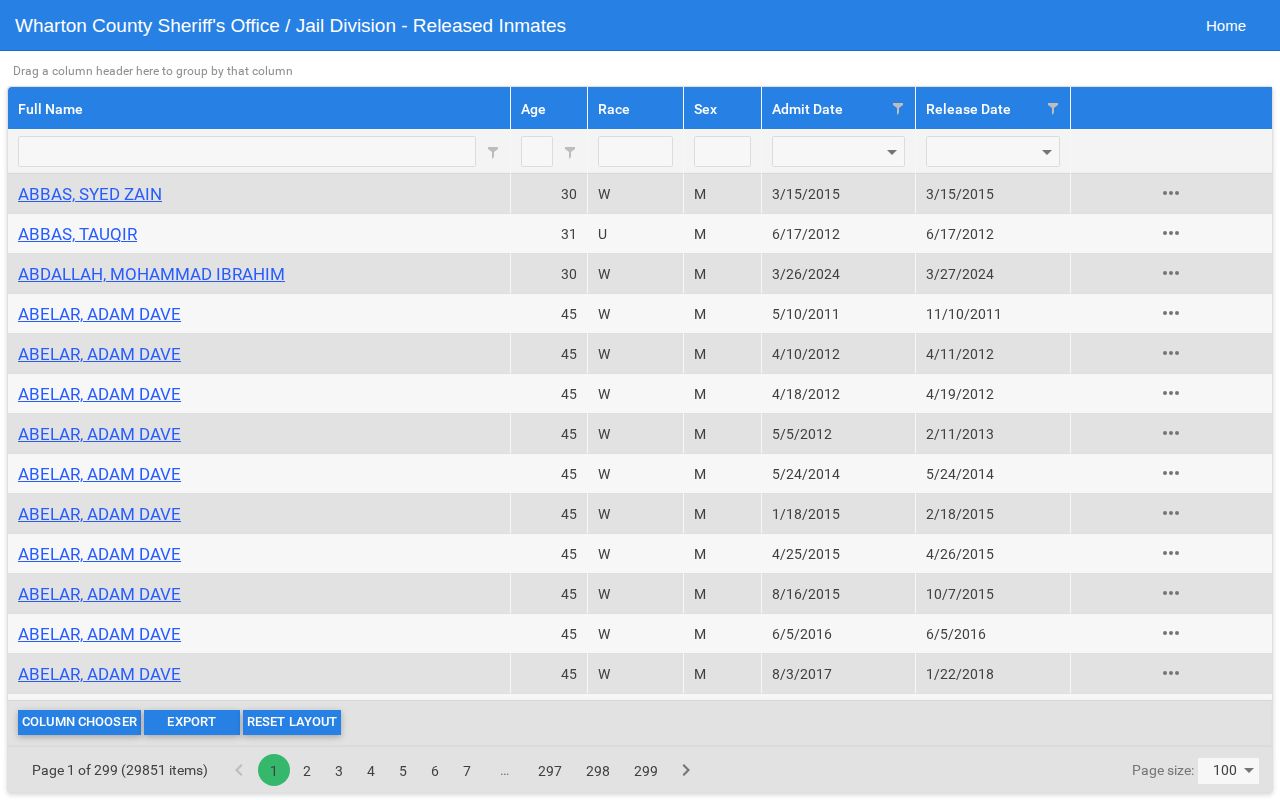
Each row leads to the precise exit fields used to verify that booking.
Verify Wharton Release Supervision
Parole follows a prison release and is supervised by the TDCJ Parole Division after a Board decision. Probation, called community supervision in Texas records, is court ordered and handled through the local CSCD. A favorable Board vote is not release because certificate, plan, condition, and audit work remains.
- Parole
- Conditional prison release while the sentence continues.
- Probation
- Court-ordered community supervision.
- Mandatory supervision
- A statutory TDCJ release with eligibility rules.
- Discharge
- Completion of incarceration and attached supervision.
Wharton Release Alerts and Transfers
Texas county notification moved from legacy VINELink to Texas IVSS-Counties in 2025. TDCJ IVSS is separate for state prison and parole events. The BOP Locator covers federal prisoners from 1982 forward, but a federal release does not settle a state detainer. ICE ODLS is only for possible immigration custody, and no result does not prove release.
The sheriff’s page still links legacy VINELink, but the Texas Attorney General states that county notifications moved to Texas IVSS-Counties on September 1, 2025. Search the county portal for the person and match the event to the booking or case. Registration can offer voice, text, or email options through the live portal. Notifications are informational and may lag. Confirm an urgent change with WCSO.
State prison notifications require TDCJ IVSS, not the county portal. TDCJ Victim Services also accepts phone, mail, and email contacts. The two systems should not be blended because a WCSO booking exit and a later TDCJ release are distinct events. A person can leave the county jail for state intake and remain confined for years.
Federal pretrial custody can be harder to trace. A U.S. Marshals detainee may be housed under contract and may not yet have a BOP number. Use the federal case, the responsible USMS district, counsel, and later the BOP Locator after designation. BOP’s displayed release date concerns federal custody only and does not clear a state warrant or detainer.
An ICE hold requires a separate civil-custody search. The ICE Online Detainee Locator accepts an A-number and country of birth or biographical data. Processing delays, transfers, age limits, and protected information can keep a person out of the public result. Contact the appropriate ERO office when the county record shows an ICE movement but the locator is silent. DHS-VINE is a separate notification service for eligible immigration victims and witnesses.
Wharton State Release Alternatives
TDCJ’s email and telephone paths matter when the online search is incomplete or a release is still being processed. The email request can return TDCJ number, location, conviction and incarceration data, incarceration history, and Projected Release Date. It does not supply public inmate photographs. Include the full name and seven-digit TDCJ number. If that number is unknown, provide exact birth date or approximate age and county of conviction.
Before a Board vote, the BPP status line is 844-512-0461. After a favorable vote, Parole Division release status is available at 512-406-5202. General inmate location and status are available at 936-295-6371 or 800-535-0283 on weekdays from 8 a.m. to 5 p.m. Exact birth date is required when the TDCJ or SID number is unknown.
Review and Release Processing checks the certificate, proposed residence, conditions, discipline, programs, and other eligibility facts. Once Classification and Records receives the certificate, an audit and date calculation follow. TDCJ cautions that a scheduled date can change even on that date. Only the later actual release or discharge record proves departure from state incarceration.
Where Wharton Release Status Appears
Each system answers a distinct question. One empty result cannot resolve all custody levels.
| System | Best use | Limit |
|---|---|---|
| WCSO Current | County jail custody now | Released people drop off |
| WCSO Released | Ended county bookings | Transfer may continue custody |
| TDCJ | State prison and supervision | Not a county archive |
| BOP | Federal custody and release | Not state or ICE status |
| ICE ODLS | Possible immigration custody | Absence is not release proof |
How Wharton Bond Releases Appear
Wharton keeps physical departure and legal cause in separate fields. An observed record paired “Release to street” under How Released with “To Bond” under Release Reason, while its charge row held bond data. This prevents bond from being mistaken for dismissal.
The county’s appearance bond form ties the promise to a cause and court. Use that docket to find the later result.
Why Wharton Releases Evade Search
DCN runs at a numeric HTTP address on port 8080 and carries a noindex instruction. Begin at the county’s HTTPS sheriff page to confirm provenance. Poor search-engine visibility does not make the official archive unavailable.
Wharton Release Details Find Courts
Court Type and Docket Number bridge jail release to disposition. Charging and Arrest Agency identify who may hold an incident report. The County Clerk portal and re:SearchTX have varied coverage, so use the named court and seek a certified judgment when needed.
Will Wharton Release Routes Change?
A 2026 county bid tabulation proves a WCSO Jail and Sheriff’s Office building project exists. It does not establish an opening, closure, capacity, or move. Recheck the physical exit and lookup link before relying on old directions.
Wharton Juvenile Releases Differ
Wharton County has no juvenile detention facility. Juvenile Probation may use Fort Bend or Victoria facilities or release a youth to a responsible person. Confidential juvenile matters belong with the responsible person, counsel, probation, and court, not the adult archive.
Find Wharton Court Dispositions
District felony matters ordinarily belong with the Wharton County District Clerk. Other matters may be with the County Clerk, a justice court, or a municipal court. DCN’s Court Type should lead the choice. Search for judgment, dismissal, sentence, jail credit, supervision, and revocation.
The County Clerk eSearch portal can require account terms, and its reach is not universal. re:SearchTX aggregates participating courts, so coverage varies. Ask the clerk for the actual judgment or dismissal. A certified copy is the authoritative court record.
If DCN names Wharton Police or El Campo Police, that department may hold the incident report. WCSO holds county booking and release records. Split requests by custodian.
Wharton Release Terms in Context
A detainer is another authority’s basis to hold or receive the person. Extradition is a legal transfer. Remand means a court sends the person into custody. Revocation can return a supervised person to confinement.
County jail credit appears in the judgment under Article 42.03. Good-conduct commutation under Article 42.032 is discretionary. No Wharton source proves everyone receives the maximum. Use the signed judgment and individual conduct record.
State good time differs. Chapter 498 links credits to parole or mandatory-supervision eligibility and says they do not otherwise shorten the sentence. Texas has no universal 85-percent rule.
Preserve Wharton Release Proof
The public grid is an active database, not a certified document. Note the admit date, release date, docket, and exit fields. A capture shows what appeared, while a sheriff-produced release sheet is the stronger stable record.
No source states how long a row remains online. A narrow PIA request can seek the booking sheet, movement log, release sheet, and photo. Ask for electronic copies and segregable public portions.
The court file completes the packet. Its judgment, dismissal, sentence, jail-credit entry, or supervision order may occur long after the jail exit.
Confirm Wharton’s Physical Release Point
The supported adult jail address is 315 E. Elm Street. The county building project means logistics should be rechecked before meeting someone. A bid tabulation does not announce an operational move. Use the sheriff page or general line for current directions.
Do not infer logistics from the database time alone. No published exit-hour, weekend, or transport policy was found. Ask whether a record means street release or transfer.
Resolve Missing Wharton Release Results
A person absent from Current mode may be in Released mode, but an empty Released search still does not settle the question. Try a prior surname, alternate spelling, and the all-released filters. Confirm the likely arrest date and whether municipal officers brought the person to WCSO. A person may never have entered the county jail, may be recorded under another identifier, or may have moved before the public entry appeared.
Call WCSO with the full name and date of birth and ask a narrow custody question. Distinguish never booked, still housed, released to street, and transferred to a named agency. A phone answer can guide the next search, though it does not replace a written record. If the result remains unclear, request the booking and movement records for the defined person and period.
A TDCJ search is warranted only when a state sentence, intake, parole, mandatory supervision, or prior state incarceration is involved. Fully discharged people may be harder to find in the current online interface. TDCJ email is the historical fallback. Ask for incarceration history, release type and date, discharge date, and supervision termination. Use the TDCJ or SID number when available.
Probation verification belongs with the sentencing court and local Community Supervision and Corrections Department. Parole verification belongs with TDCJ and the Parole Division. A probation order does not prove a prison release, and a parole status does not resolve every county charge. Match the supervision record to the same cause or sentence.
For federal cases, search the BOP number or name and read the federal docket. A person may be in USMS custody before BOP designation. For an immigration handoff, use the ICE locator with the correct A-number and country or biographical data. If processing or privacy rules hide a result, contact ERO. Never treat locator silence as proof of return to the community.
Finally, compare dates across all sources. The jail exit, receiving intake, court event, and supervision start may occur on different dates. Small gaps can reflect transport and processing. Large conflicts call for an agency record, not a guess. A clear conclusion names which custody ended, when it ended, why it ended, and which source confirms what happened next.
Wharton County Release Facilities
Eight systems form the local custody map. WCSO is the adult jail. Wharton and El Campo police initiate applicable arrests. Fort Bend and Victoria may house juveniles by contract. TDCJ, BOP, and ICE require separate search channels.
- Wharton County Jail
- Wharton Police Department
- El Campo Police Department
- Fort Bend juvenile detention
- Victoria juvenile detention
- Texas Department of Criminal Justice
- Federal Bureau of Prisons
The eighth route, ICE detention, may follow a county detainer transfer and is not community release.
Municipal arrest records and jail records also have different custodians. Wharton or El Campo police may hold the incident report, WCSO holds the county booking and release record, and the named clerk holds the case result. Split a request accordingly. Asking one office to certify another office’s work can delay a clear answer.
TDCJ has no state prison unit located in Wharton County. A person sentenced from Wharton may be housed anywhere in the state system. BOP facilities are likewise nationwide. Those facts make the booking’s destination and receiving identifier more useful than geographic assumptions.
Fort Bend and Victoria juvenile facilities are contract routes, not public adult-jail search targets. The responsible person, counsel, Juvenile Probation, and juvenile court hold the proper confirmation path. Federal and immigration systems also remain outside WCSO’s authority after a handoff. Keeping each custodian distinct makes a Wharton County release conclusion both more precise and easier to verify later. Dates should always be recorded with the source.