
Wharton Parole and Probation
Parole is conditional release from a Texas Department of Criminal Justice prison. The Texas Board of Pardons and Paroles makes the release decision, and the TDCJ Parole Division supervises the person after release. The person still serves the balance of the sentence outside prison and must follow the imposed conditions. Mandatory supervision is another state-law route from prison to supervision. It may be automatic under older law for an eligible case, but Board approval is required for eligible offenses committed on or after September 1, 1996.
Probation begins with a court judgment, not a prison-release vote. Texas statutes and offices often call it community supervision. A Community Supervision and Corrections Department administers the court's terms. For a Wharton County case, the signed judgment is the best starting point because it identifies whether the sentence is community supervision, confinement, or another result. A person may leave Wharton County Jail to begin probation, but the jail's release field alone does not establish the terms or supervising county.
| Record type | Decision maker | Best confirmation |
|---|---|---|
| Parole | Texas Board of Pardons and Paroles | TDCJ person detail, Parole Review Information, and Parole Division |
| Mandatory supervision | Texas law and, for later eligible offenses, Board review | TDCJ status, release certificate, and supervision record |
| Probation / community supervision | Sentencing court | Signed judgment, docket, and the responsible CSCD |
| Discharge | Controlling sentence and agency records | TDCJ incarceration history or court discharge order |
These labels should not be blended. A Wharton County Jail record may say that someone was released to the street or to bond. That describes departure from local custody. It does not say the person is on parole, and bond is not probation. The court docket can show whether a pending case later produced community supervision.
- Parole
- Conditional release from TDCJ incarceration before the sentence ends.
- Probation
- Court-ordered community supervision, often imposed instead of a jail or prison term.
- Discharge
- Completion of the controlling incarceration and supervision obligation shown by the official record.
- Revocation
- An agency or court process that may end supervision and return a person to custody.
Verify Wharton Release Supervision
Start with the system that imposed or received the sentence. The WCSO released archive confirms that a person left Wharton County Jail and identifies useful court and docket fields. A state-prison transfer or sentence requires the TDCJ inmate search. Probation requires the judgment and the court record. Searching all three without first matching identifiers can join unrelated records for people with similar names.
- Open the Wharton release detail and record the full name, booking data, court type, and docket number. Read How Released and Release Reason separately.
- If TDCJ custody is involved, search by TDCJ number or SID when possible. A number is more reliable than name spelling. Open Offender Information Details and Parole Review Information.
- For probation, locate the signed sentencing judgment through the correct clerk. The Wharton County Clerk portal and the District Clerk cover different court jurisdictions.
- Ask the responsible office whether supervision is active, transferred, completed, revoked, or discharged. Some location or case information may be withheld.
- Preserve the official record date. A later order, transfer, violation, or discharge can change the answer.
A favorable parole vote is not proof that release occurred. TDCJ Review and Release Processing still checks the proposed residence, required programs, conditions, discipline, and certificate. Only a release status or actual release entry confirms departure from prison. Likewise, a projected date is a calculation, not an event.
Wharton Supervision Record Channels
No single public Wharton County page combines parole and probation. State parole questions move through TDCJ and the Board. Community-supervision questions move through the sentencing court and the responsible CSCD. A case can also transfer supervision to another county, so the county of conviction is not always the current reporting location.
Before a Board vote, the Texas Board of Pardons and Paroles status line is 844-512-0461. After a favorable vote, the TDCJ Parole Division release-status line is 512-406-5202. General state offender location and status are available at 936-295-6371 or 800-535-0283 on weekdays from 8 a.m. to 5 p.m. An exact birth date is required when the TDCJ or SID number is unknown.
8610 Shoal Creek Boulevard
Austin, TX 78757
512-406-5449
Release-plan, certificate, and processing channel
For a formal state-history request, email TDCJ offender information with the full name and seven-digit TDCJ number. If the number is unknown, supply an exact birth date or approximate age and county of conviction. Ask for incarceration history, release type and date, discharge date, and supervision termination. TDCJ states that this information is supplied without charge. Questions about a person already under parole supervision go to the Parole Division channel, while public-information requests go to TDCJ's public-information office.
Wharton Release Status Changes
Conditions are person-specific. They can include reporting rules, residence approval, treatment, travel limits, or other terms in the certificate or court order. A public jail page cannot establish compliance. When a concern is urgent, use the named supervising office, court, or appropriate law-enforcement channel instead of drawing a conclusion from an old release row.
An absconder is a supervised person alleged to have stopped reporting or left supervision under agency rules. It does not merely mean released. The TDCJ Sex Offender Absconder Information Search covers a narrow category, not all parole absconders. Absence from that search cannot prove that a warrant was cleared or never existed. The Texas DPS registry is also limited to people required to register, so it is not a general post-release locator.
Notification tools have separate scopes. Texas IVSS-Counties can carry participating county jail and court events. TDCJ IVSS covers state corrections notifications. Neither replaces the signed probation order or the Parole Division record. Alerts may lag, and a transfer can look like release from the sending facility.
Texas Government Code Chapter 508 governs much of parole and mandatory supervision. Eligibility rules in sections 508.145 and 508.149 depend on offense, date, and sentence. They do not create a universal release formula.
Confirm Wharton Supervision Discharge
Supervision ends through the authority that controls it. For parole or mandatory supervision, request TDCJ history that identifies the release type, release date, and supervision termination or discharge date. The word released may mean the person left prison while still serving the sentence under supervision. Discharged is the stronger term when the official record shows the sentence and related supervision have ended.
For probation, use the signed court order showing completion, early termination, revocation, or another disposition. A docket entry can help locate the action, but a certified order is more durable proof. The Wharton County jail release record remains useful because its Court Type and Docket Number direct the search to the correct clerk. The Wharton County released inmate search explains how the local custody record and court disposition fit together.
Texas public-record law starts from access to completed governmental records, subject to exceptions. A focused request for an existing discharge order or defined supervision record is more workable than asking an agency to answer a broad question. Under Government Code Chapter 552, an office may seek clarification, assess allowed costs, or withhold protected details under a cited exception. Juvenile, victim, medical, safety, sealed, and expunged material can require different treatment.
A discharge does not erase the court case. Expunction under Texas Code of Criminal Procedure Chapter 55A and nondisclosure under Government Code Chapter 411 are separate court-based remedies with fact-specific eligibility. Neither should be inferred from an empty public search. Note: Match the person, cause number, record date, and supervising authority before treating a Wharton supervision result as final.
Wharton Parole Review Timing
Texas parole review is not a daily Wharton County courthouse calendar. The Board identifies an initial review about six months before eligibility and a later review about four months before its review date. An Institutional Parole Officer prepares a case summary, then a three-member panel votes in sequence. Two matching votes make the decision. The person receives notice by correspondence.
The official Board review-process page is the schedule and cadence source. Its voting language includes approval forms such as FI-1, future-date and program-conditioned decisions, plus denial or later-review outcomes. Those codes describe Board action, not passage through the prison gate.
The official source shown below presents the Texas parole review sequence used when a Wharton County TDCJ record lists Parole Review Information.
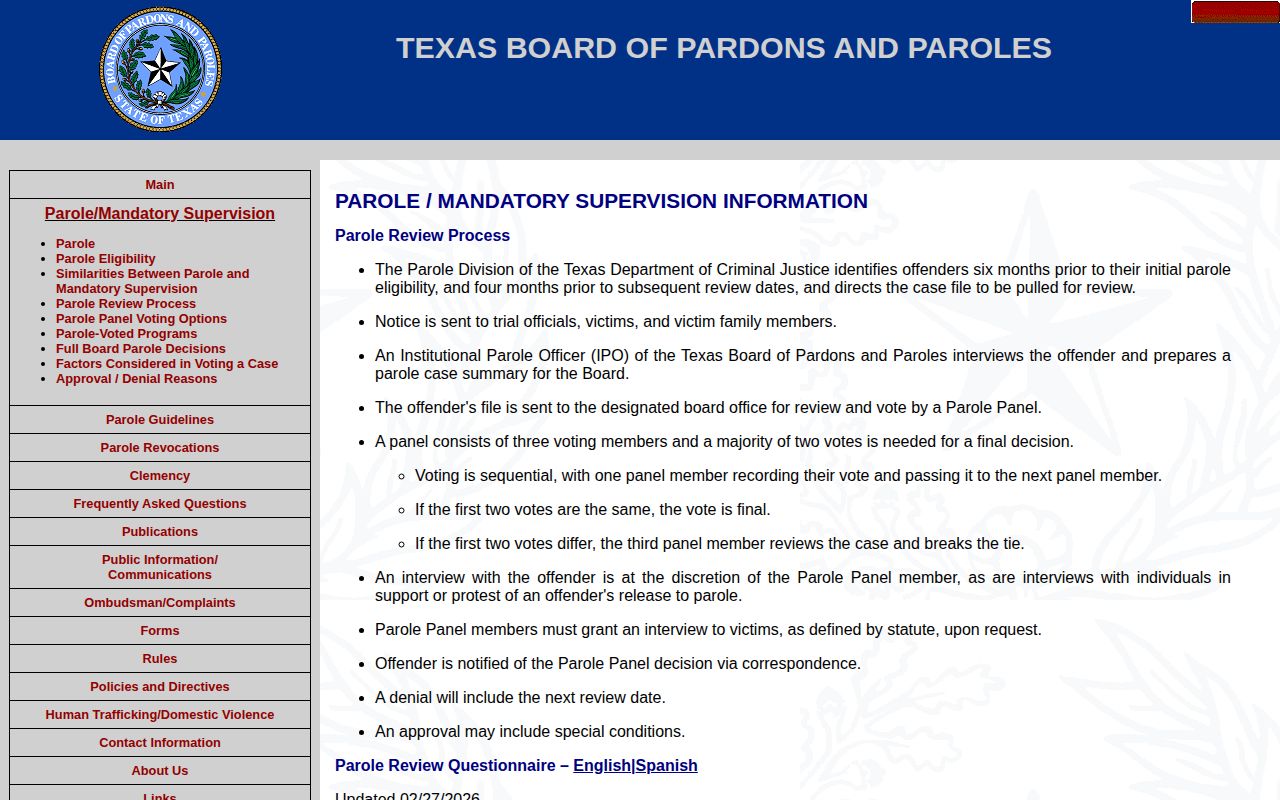
Read that statewide sequence beside the person-specific TDCJ detail. A vote can be withdrawn when new information arrives, and release processing follows any favorable vote.
Date Wharton Supervision Records
A supervision answer can change after transfer, revocation, completion, or discharge. Record the date of each TDCJ screen, court order, and office response. When sources differ, ask the authority that created the disputed field. WCSO controls its jail release entry, TDCJ controls state status, and the sentencing court controls probation orders. Keeping those roles separate prevents an old release event from being mistaken for current supervision.
Search Supervision Records
Sponsored Results